
By Conservation Outreach Volunteer, Terren Hazzard
With a last name like mine, Hazzard, I could not pass up the opportunity to share information about hazardous plants in the Edmonton area!
There are not many, but there are a few hazardous plants that we should be aware of when exploring the Edmonton River Valley and beyond. Today, we are going to talk about hazardous and similar non-hazardous plants you could stumble upon in your everyday life.
Giant hogweed vs. Cow parsnip
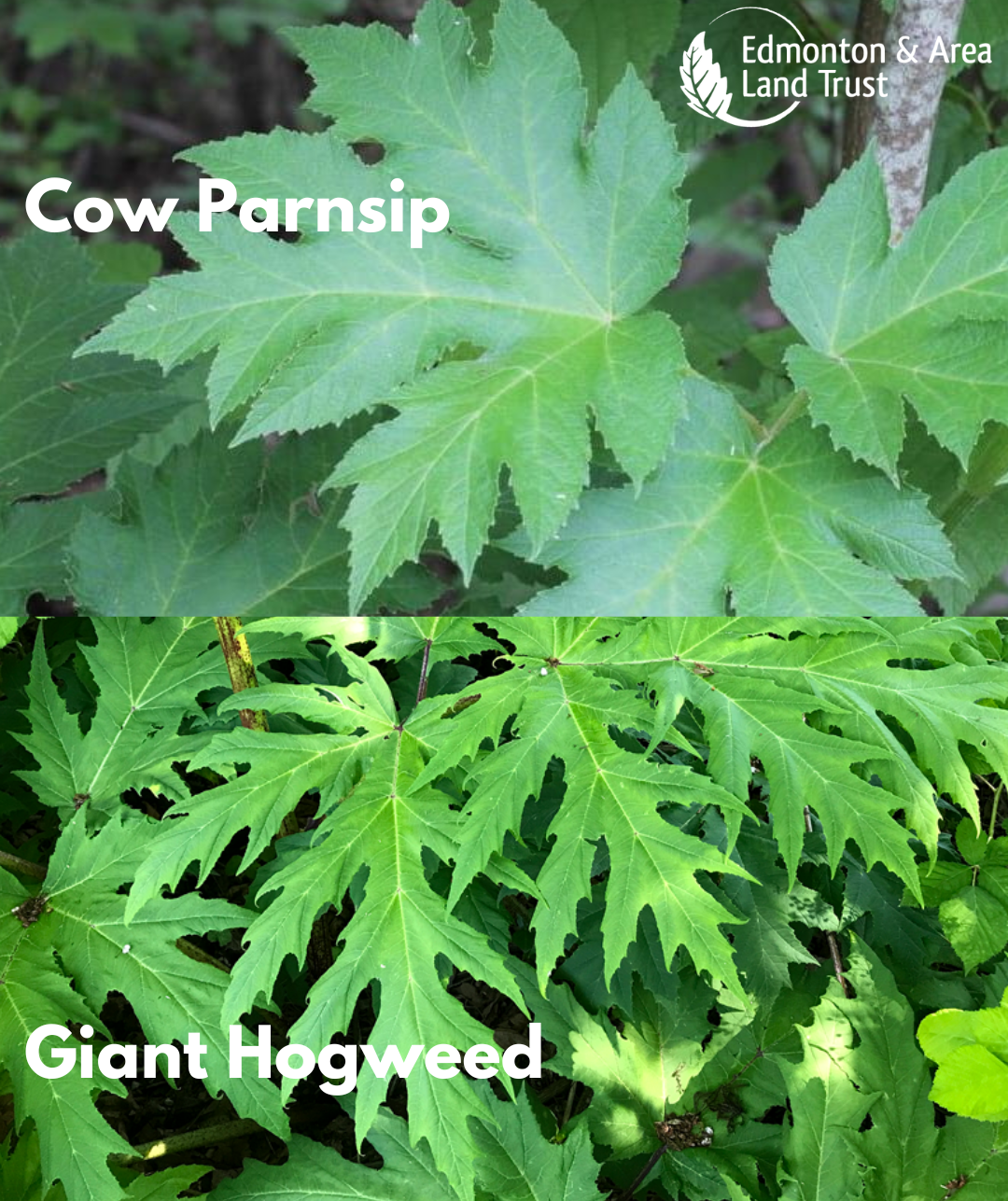
When you are looking out for plants that can cause harm, it is good to be aware of what is likely to find in the area.
Giant Hogweed has NOT been confirmed in Alberta, so it is extremely unlikely to encounter it.
However, to get more familiar with plant identification and to keep an eye out for this plant, here are some tips for comparing it with a common native plant, cows parsnip. At first glance, giant hogweed and cow parsnip can look similar when they are not compared side by side. They both have gorgeous white compound umbels. Giant hogweed is considered an aggressive prohibited noxious weed. It favours moist, organic material rich soil and you can find the plant in areas with water logged soils or on riparian lands. The easiest way to tell the two plants apart is by comparing their sizes. Giant hogweed averages 3 to 6 metres tall, while Cow parsnip is typically only 1 to 2.5 metres tall. The two plants also have different shaped leaves. Cow parsnip has compound, palmate leaves that some describe as a wonky maple leaf, while Giant hogweed has compound, lobed leaves with deep incisions. If you touch Giant hogweed, you can also be exposed to a clear sap that reacts with sunlight that causes burns and blisters that can scar. Cows parsnip also has sap that can cause a similar, but much more mild reaction. As with many hazardous plants, the easiest way to care for these blisters is to carefully clean the sap from your hand, apply a gentle cream, and cover it to keep it clean. It is important to monitor these blisters because they can lead to a horrible hospital stay. If you do not see them get better, or if they are growing worse, it is important to consult a doctor.
Water hemlock vs. Yarrow
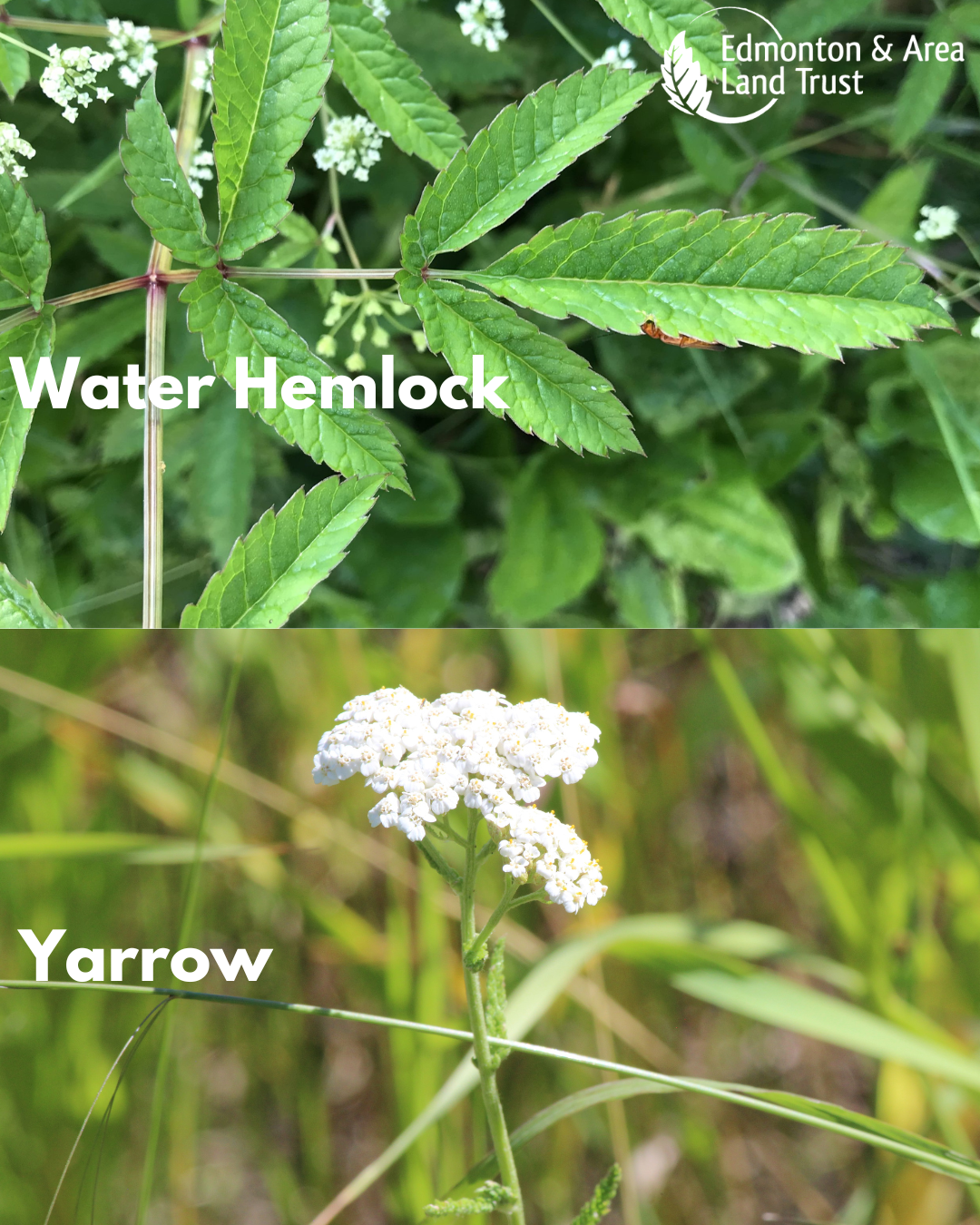
Water hemlock and Yarrow are also two plants with white umbels found in wetlands and irrigated areas. Water hemlock is a highly toxic plant that can cause many deadly symptoms. While we typically do not eat the random plants we see in fields, ditches, and open areas, animals do. For instance, in St. Paul water hemlock has been grazed on by livestock, resulting in asphyxiation and death. It is a poison that can cause seizures, muscle twitching, excessive salivation, a rapid pulse and breathing, dilated pupils, and possibly a coma and death. That sounds terrifying, but by recognizing the plant, we can avoid it, fence off areas that contain the plant, and remove it from pastures and wetlands to protect our livestock. Water hemlock can be differentiated by other plants with white umbels by their rounded, pale green stem and feather-like lance-shaped leaflets. Their roots are an important identifying feature and must be removed carefully while wearing protective gear. The roots are tuberous with hollow horizontal chambers. In these chambers, you can find the yellow poisonous cicutoxin that is so harmful. Yarrow, on the other hand, is not hazardous. I personally would not eat it, but it is not poisonous. The easiest way to tell Yarrow apart from Water hemlock is by comparing their leaves. Both species have opposite leaves and leaflets, but Yarrow has toothy, thin leaflets, while Water hemlock has lance-shaped, broad leaflets.
Poison ivy vs. Manitoba maple seedlings
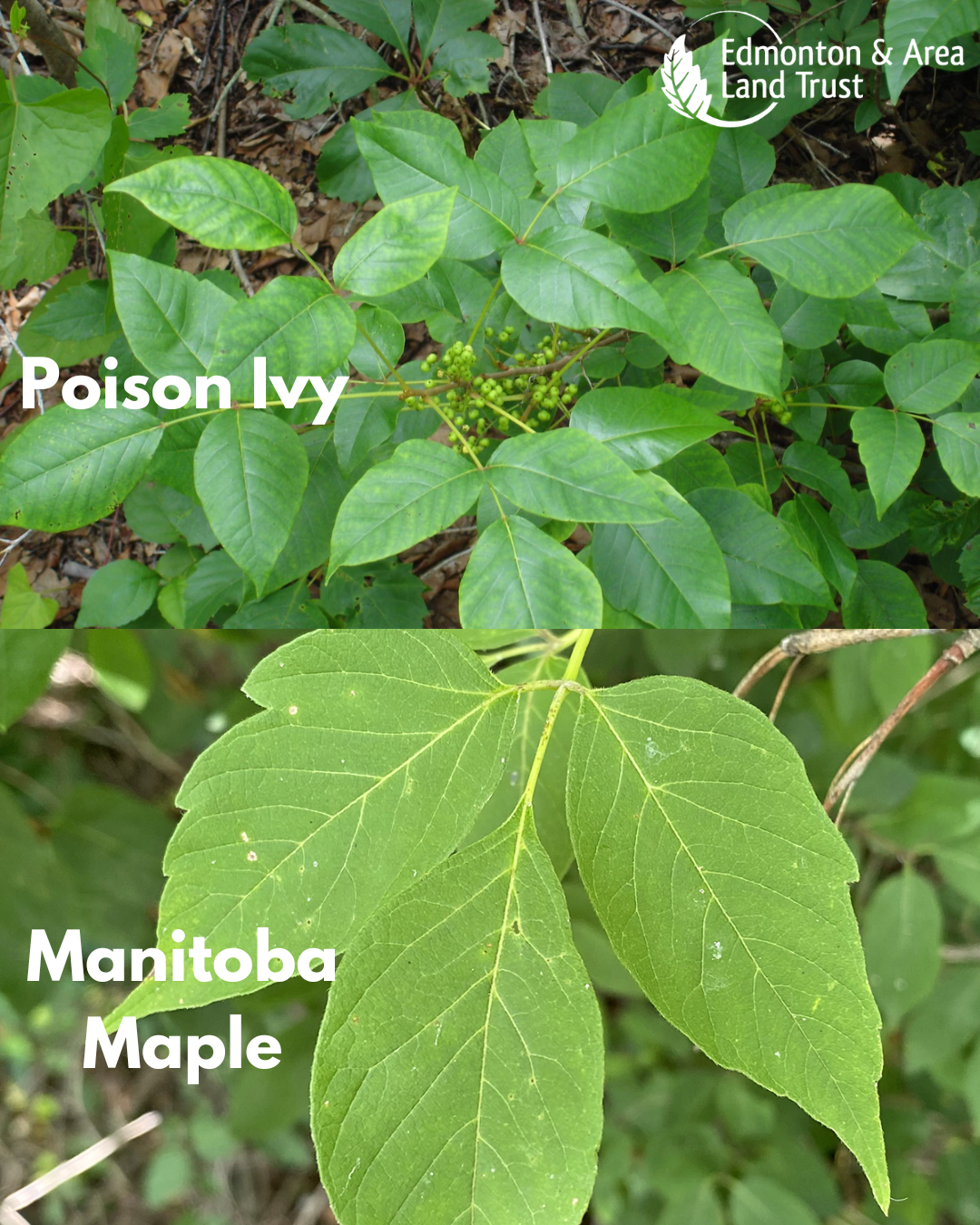
Poison ivy is the one hazardous plant that is in every survival movie.
Once again, considering your habitat and likelihood of occurrence is important. Poison ivy, Toxicodendron radicans, can be found in Alberta, but is not commonly seen.
The classic phrase “leaves of three, let it be” has made the plant famous, but do we actually know how to identify it? Many plant species have three leaflets, but luckily, the Canadian Museum of Nature outlined a great way to tell the plant apart from every other plant with three leaves. The key identifying feature is the pointed leaf tip. Surprisingly, Manitoba maple can be mistaken for Poison ivy. This sounds unlikely, because it sounds impossible to mistake a tree for Poison ivy, but it is not the tree that is mistaken, but the seedlings. In Edmonton, poison ivy is rare. You are much more likely to find Manitoba maple seedlings. They are very similar, but Poison ivy has entire margins with little serration, while Manitoba maple seedlings have clear serrations on their leaves. Manitoba maple seedlings also grow to be trees, while Poison ivy can wrap around trees.
When in doubt, if you do not know what the plant is, do not touch it or eat it.
Exploring the city and learning about the wide range of plant diversity we have is a great way to spend the summer. On the weekends, I encourage you to take time to borrow a plant field guide from the library and explore! The natural areas in and around the city have so much to offer, and I hope this has helped you stay a little more safe on your adventures.